
If you’re asking “How does an AHU work?”, you’re likely involved in building services, facilities management, electrical installation, or HVAC design.
An Air Handling Unit (AHU) is the heart of many commercial HVAC systems. It regulates airflow, temperature, humidity and indoor air quality across offices, hospitals, schools, data centres and industrial facilities.
While many blogs explain that an AHU “heats, cools and distributes air,” the real operation of an AHU is more sophisticated. Its performance depends not just on mechanical components, but on intelligent AHU controls, airflow balancing, and energy optimisation strategies.
In this in-depth guide, we’ll cover:
- What an AHU is and how it works step by step
- The internal components of an AHU
- The airflow process explained clearly
- How AHUs maintain indoor air quality
- The importance of AHU control panels
- Energy efficiency and compliance considerations
- How specialist AHU control expertise improves performance
Table of Contents
- What Is an AHU?
- How Does an AHU Work? (Step-by-Step Process)
- Key Components Inside an AHU
- Types of AHUs in Commercial Buildings
- How AHUs Maintain Indoor Air Quality
- How AHU Controls Optimise Performance
- Energy Efficiency & UK Compliance
- Common AHU Faults & Performance Issues
- FAQs – How Does an AHU Work?
- Conclusion
1. What Is an AHU?
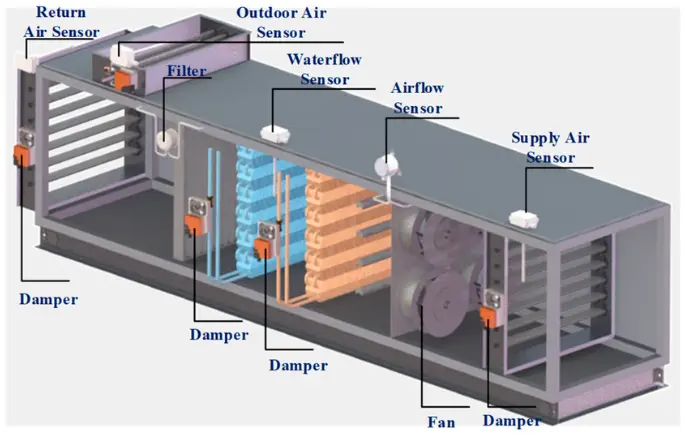
An Air Handling Unit (AHU) is a large metal enclosure containing components that condition and circulate air as part of an HVAC system.
It is typically connected to:
- Ductwork (for air distribution)
- Chilled water or DX cooling systems
- Heating systems (LTHW, electric or steam)
- A Building Management System (BMS)
The AHU itself does not generate cooling or heating energy. Instead, it transfers thermal energy between air and water (or refrigerant) while controlling airflow and filtration.
2. How Does an AHU Work? (Step-by-Step Process)
To properly understand how an AHU works, we must follow the airflow path through the unit.
Step 1: Fresh Air Intake & Return Air Mixing
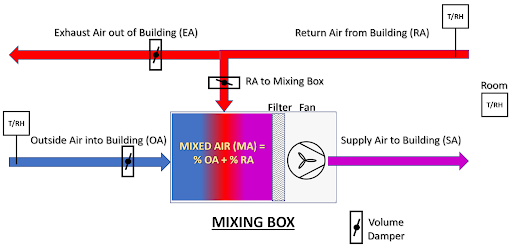
An AHU draws in:
- Fresh outdoor air
- Recirculated return air
Motorised dampers regulate the proportion of fresh and return air to maintain indoor air quality and energy efficiency.
Step 2: Air Filtration
Air passes through filter sections designed to remove:
- Dust
- Particulates
- Pollen
- Bacteria
Modern systems comply with ISO 16890 filter classifications to ensure air quality performance.
Step 3: Heating or Cooling Coils
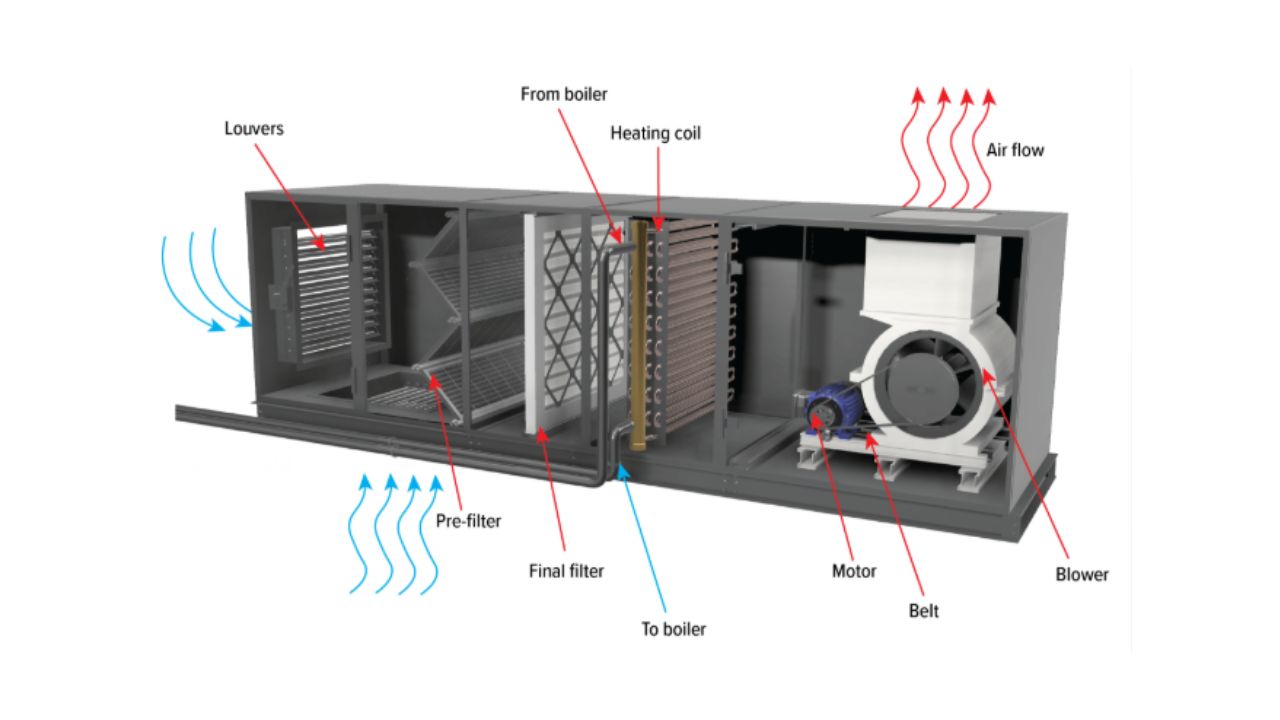
After filtration, air passes across coils:
- Cooling coil (chilled water or DX)
- Heating coil (LTHW, electric or steam)
If cooling is required:
- Warm air transfers heat to chilled water.
- Supply air temperature drops.
If heating is required:
- Warm water transfers heat to air.
- Supply air temperature increases.
This heat exchange process is central to how an AHU works.
Step 4: Fan Section
The supply fan pushes conditioned air into the ductwork system.
Modern AHUs use:
- Centrifugal fans
- Plug fans
- EC fan arrays
Fan energy consumption can be significant. Because fan power follows the cube law, small reductions in speed can produce large energy savings.
Step 5: Air Distribution
Conditioned air travels through ductwork to occupied spaces.
Return air then cycles back to the AHU to repeat the process.
This continuous loop explains how an AHU works to maintain stable environmental conditions.
3.
Key Components Inside an AHU
The internal design of an AHU typically includes:
- Mixing box with dampers
- Pre-filters and fine filters
- Heating and cooling coils
- Heat recovery sections (if installed)
- Supply and return fans
- Humidifiers (where required)
- Sensors (temperature, pressure, CO₂)
Each component must operate correctly for the AHU to work efficiently.
4. Types of AHUs and Their Applications
Modular AHUs
Custom-built for large commercial and industrial sites.
Packaged AHUs
Pre-assembled for medium-scale applications.
Rooftop AHUs
Weatherproof units installed externally.
Hygienic AHUs
Designed for healthcare and cleanroom environments.
The way an AHU works remains similar across types, but application and control complexity vary.
5.
How AHUs Maintain Indoor Air Quality (IAQ)
AHUs contribute to IAQ through:
- Continuous ventilation
- Air filtration
- Controlled fresh air supply
- Humidity management
- Pressure balancing
CO₂ sensors monitor occupancy levels, allowing ventilation rates to adjust dynamically.
Without proper airflow control, indoor environments may suffer from:
- Stale air
- High CO₂ levels
- Condensation
- Temperature imbalance
6. How AHU Controls Optimise Performance
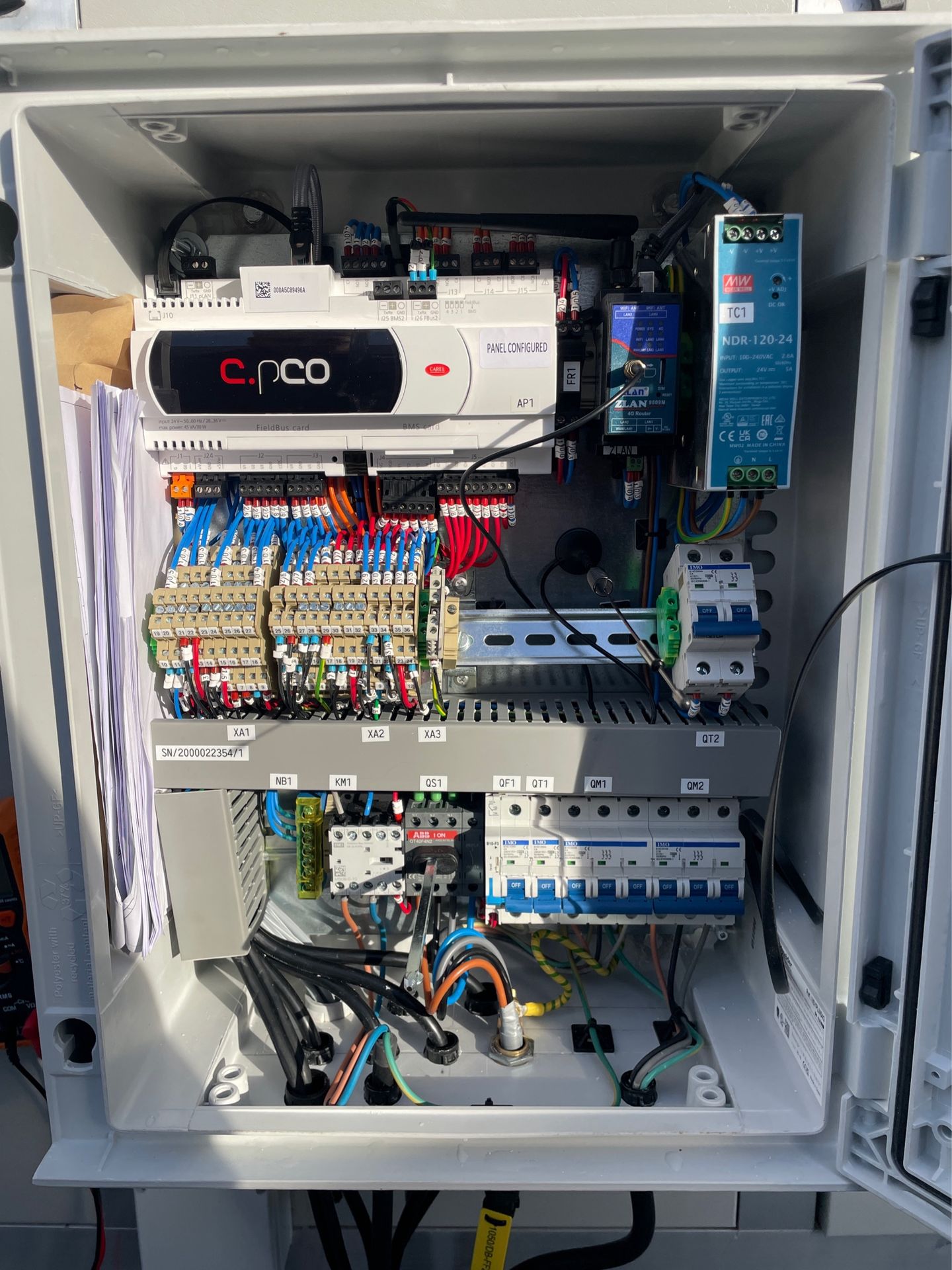
Understanding how an AHU works is incomplete without understanding AHU controls.
The AHU control panel regulates:
- Fan speed (via VSDs)
- Temperature setpoints
- Damper position
- Coil valve modulation
- Frost protection
- Static pressure control
- BMS communication
Leading manufacturers such as Danfoss (VSDs), Belimo (actuators), Sontay (sensors), and Siemens (controllers) enable intelligent optimisation.
Our AHU Controls Expertise
At iACS, we specialise in:
- AHU control panel manufacturing
- Bespoke HVAC control strategies
- BMS integration
- System optimisation upgrades
- Distribution of over 6000 HVAC control components
We design panels that ensure AHUs:
- Operate efficiently at part load
- Avoid simultaneous heating and cooling
- Reduce fan energy consumption
- Comply with Part L requirements
- Deliver measurable energy savings
Mechanical components determine capacity, but control strategy determines performance.
7. Energy Efficiency & UK Compliance
Modern AHUs must meet:
- Part L Building Regulations
- SBEM modelling targets
- BREEAM standards
- Net-zero carbon objectives
Key efficiency drivers include:
- Specific Fan Power (SFP)
- Heat recovery efficiency
- Variable speed operation
- Demand-controlled ventilation
Without intelligent AHU controls, achieving compliance targets becomes significantly more difficult.
8. Common AHU Design & Performance Mistakes
- Oversized fans running at constant speed
- Poorly calibrated sensors
- Incorrect valve control
- Inadequate frost protection logic
- Lack of BMS integration
Most operational inefficiencies are control-related rather than mechanical failures.
9. FAQs – How Does an AHU Work?
How does an AHU cool air?
It passes air over a chilled water or DX coil, transferring heat from the air to the cooling medium.
How does an AHU heat air?
Warm water or electric heating elements raise the supply air temperature.
Does an AHU bring in fresh air?
Yes. Dampers regulate the intake of fresh outdoor air to maintain indoor air quality.
Why are AHU controls important?
AHU controls optimise airflow, temperature regulation, energy efficiency and compliance.
Can upgrading AHU controls improve efficiency?
Yes. Retrofitting modern control panels can significantly reduce energy consumption without replacing the entire unit.
Conclusion: How Does an AHU Work? It Works Through Intelligent Integration
An AHU works by continuously drawing in, filtering, conditioning and distributing air throughout a building. It balances temperature, ventilation and humidity to create safe and comfortable indoor environments.
However, the real-world efficiency of an AHU depends heavily on advanced control strategies.
For building owners, contractors and engineers, understanding how an AHU works means recognising that performance is driven not just by mechanical components — but by intelligent control integration.