
An Air Handling Unit (AHU) is one of the most important components in modern commercial HVAC systems. Found in offices, hospitals, shopping centres, manufacturing facilities and educational buildings, an AHU is responsible for regulating airflow, controlling temperature and maintaining indoor air quality.
While many explanations describe an AHU simply as a “large box that moves air,” the reality is far more technical. Today’s AHUs are engineered systems designed to meet strict energy efficiency standards, ventilation regulations and environmental performance targets.
In this comprehensive guide, we explore:
- What an AHU is
- The primary function of an AHU
- The internal components of an AHU
- How an AHU works step-by-step
- Why AHU controls are essential for performance
- Energy efficiency and compliance considerations
Table of Contents
- What Is an Air Handling Unit (AHU)?
- What Is the Function of an AHU?
- Main Components of an AHU
- How Does an AHU Work?
- Types of AHUs
- The Importance of AHU Controls
- Energy Efficiency & Compliance
- FAQs About AHUs
- Conclusion
1. What Is an Air Handling Unit (AHU)?
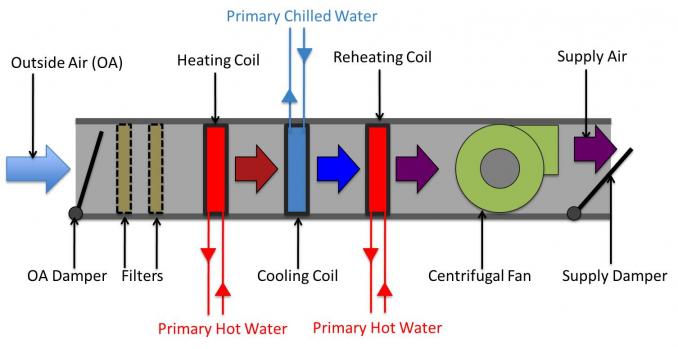
An Air Handling Unit (AHU) is a central HVAC device that conditions and circulates air throughout a building. It is typically connected to ductwork and works alongside chillers, boilers, heat pumps or heat recovery systems.
AHUs are commonly installed in:
- Commercial offices
- Healthcare facilities
- Airports
- Data centres
- Retail centres
- Industrial plants
They are usually located in plant rooms, rooftops or dedicated mechanical spaces.
2. What Is the Function of an AHU?
The primary function of an AHU is to treat and distribute air to maintain a comfortable and healthy indoor environment.
Core Functions of an AHU:
1. Air Circulation: Moves air through the building using supply and return fans.
2. Temperature Control: Adjusts air temperature using heating and cooling coils.
3. Ventilation: Introduces fresh outdoor air and removes stale indoor air.
4. Air Filtration: Removes dust, particulates and airborne contaminants.
5. Humidity Regulation: Maintains appropriate moisture levels where required.
In short, the AHU ensures that air is:
- Clean
- Conditioned
- Properly ventilated
- Evenly distributed
3. Main Components of an AHU
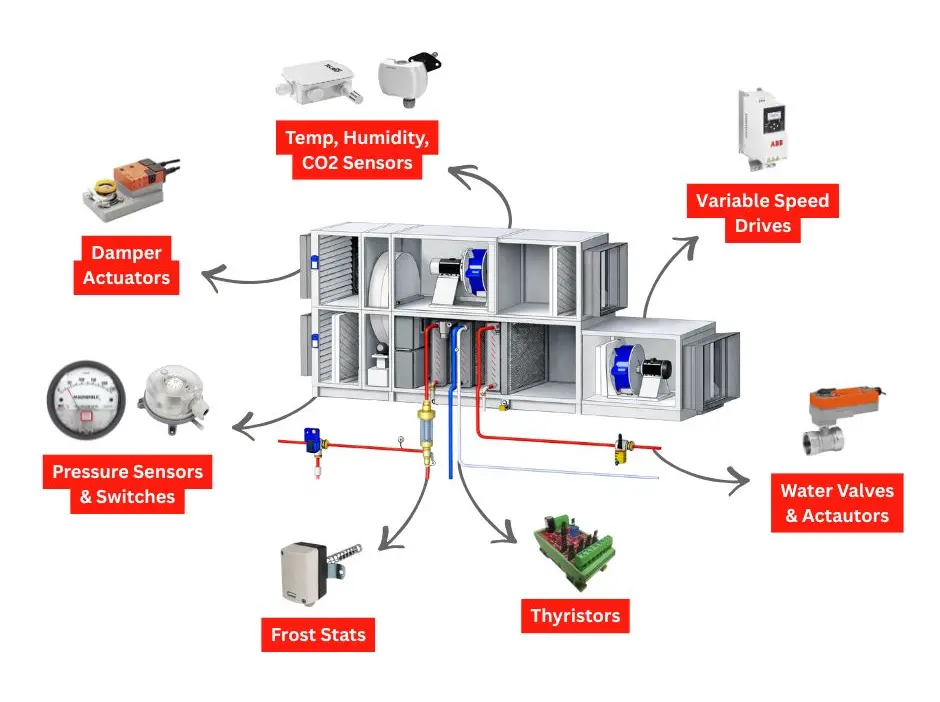
An AHU consists of several integrated sections:
Mixing Box & Dampers
Control the ratio of fresh air and recirculated air.
Filters
Remove dust and pollutants. Modern systems comply with ISO 16890 filtration standards.
Heating Coil
Uses hot water, steam or electric elements to warm air.
Cooling Coil
Uses chilled water or refrigerant to cool air.
Fans
Supply and return fans move air through the system.
Heat Recovery (Optional)
Recovers energy from exhaust air to improve efficiency.
Sensors
Monitor temperature, pressure and air quality.
4.
How Does an AHU Work?
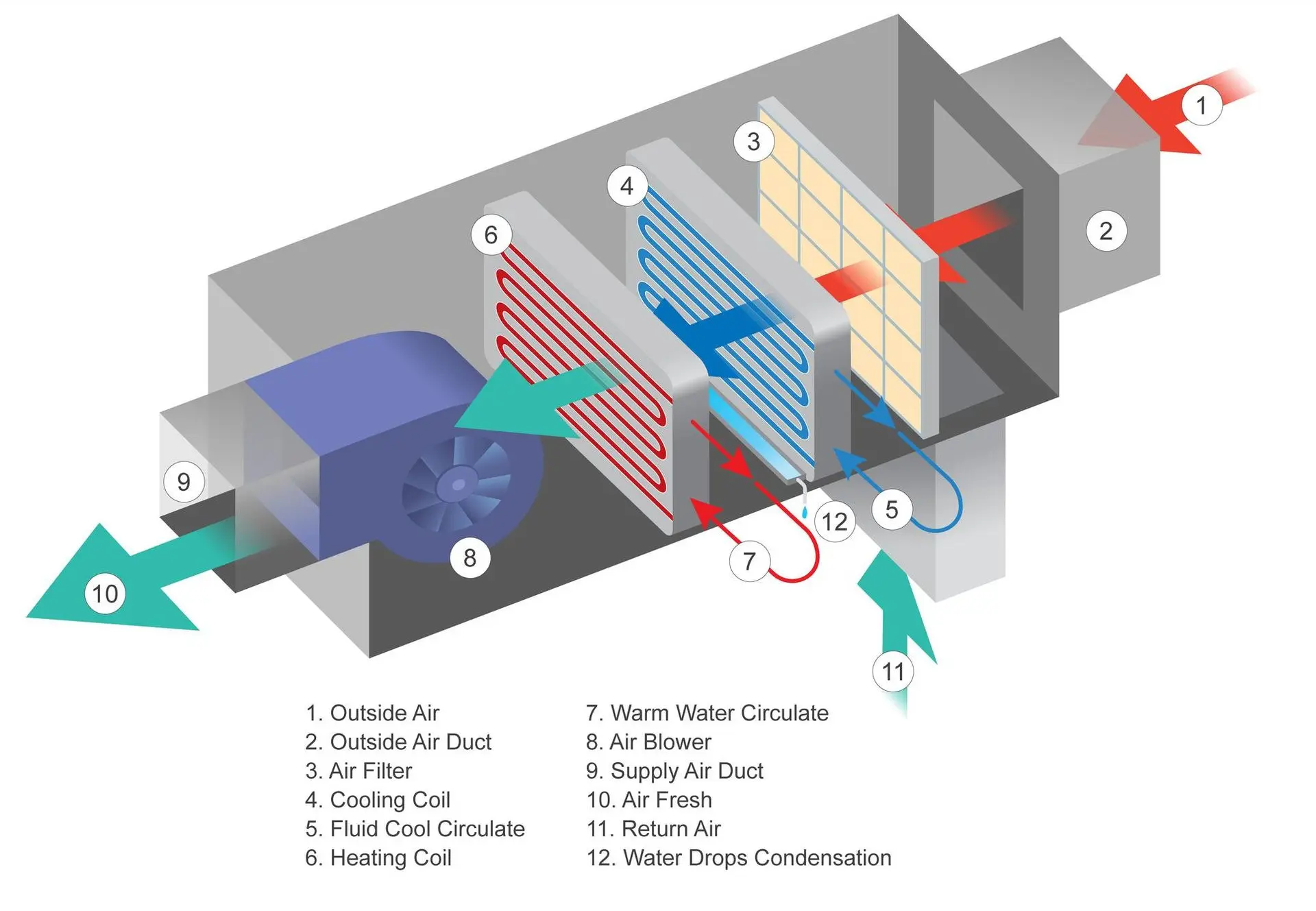
Understanding how an AHU works requires following the airflow path:
Step 1: Air Intake
Fresh outdoor air and return air enter the mixing chamber.
Step 2: Filtration
Air passes through filters to remove contaminants.
Step 3: Heating or Cooling
Air flows over coils to adjust temperature.
Step 4: Air Distribution
Fans push conditioned air into ductwork.
Step 5: Return Air Cycle
Air returns to the AHU to repeat the process.
This continuous cycle maintains consistent indoor conditions.
5. Types of AHUs
Modular AHUs
Custom-built systems for large commercial buildings.
Packaged AHUs
Pre-assembled units for medium applications.
Rooftop AHUs
Weatherproof units installed externally.
Hygienic AHUs
Designed for healthcare and pharmaceutical environments.
Each type serves specific ventilation and performance requirements.
6. The Importance of AHU Controls
While mechanical components enable air treatment, AHU controls determine efficiency and reliability.
An AHU control panel manages:
- Fan speed via variable speed drives (VSDs)
- Heating and cooling valve modulation
- Damper positioning
- Static pressure control
- Frost protection
- CO₂-based demand ventilation
- Communication with Building Management Systems (BMS)
Leading manufacturers such as Danfoss (VSDs), Belimo (actuators), Sontay (sensors), and Siemens (controllers) provide components commonly used in AHU control systems.
Without intelligent control:
- Fans may run continuously at full speed
- Energy may be wasted through over-ventilation
- Simultaneous heating and cooling may occur
- Compliance targets may not be achieved
Modern AHU control strategies optimise performance and significantly reduce energy consumption.
7. Energy Efficiency & Compliance
AHUs must meet strict performance standards in commercial buildings, including:
- Specific Fan Power (SFP) requirements
- Heat recovery efficiency targets
- Air leakage limitations
- Building Regulations Part L (UK)
Energy-efficient AHUs with advanced control panels help:
- Reduce operational costs
- Lower carbon emissions
- Improve seasonal efficiency
- Achieve compliance with regulatory standards
8.
FAQs About AHUs
What does an AHU do in HVAC?
An AHU conditions, filters and distributes air while maintaining ventilation and temperature control.
Does an AHU bring in fresh air?
Yes. Dampers regulate fresh air intake to maintain indoor air quality.
What is the difference between an AHU and HVAC?
HVAC refers to the entire heating, ventilation and air conditioning system. The AHU is one component within that system.
Why are AHU controls important?
AHU controls regulate airflow and temperature to improve efficiency and prevent energy waste.
9. Conclusion
An Air Handling Unit is far more than a ventilation device, it is a central environmental control system that ensures buildings remain comfortable, healthy and energy-efficient.
From filtration and temperature regulation to airflow management and compliance performance, AHUs play a vital role in modern HVAC systems.
However, true efficiency depends not only on mechanical components but also on intelligent control systems that optimise performance in real time.
Understanding both the function and control of AHUs is essential for delivering reliable and energy-efficient HVAC solutions.