
An Air Handling Unit (AHU) is one of the most critical components in non-residential ventilation and indoor air quality (IAQ) systems. Found in commercial offices, hospitals, airports, data centres and industrial facilities, the AHU is responsible for delivering conditioned, filtered and properly ventilated air throughout a building.
While many explanations describe an AHU simply as “a box that moves air,” this overlooks the complexity of modern systems. Today’s AHUs are engineered to meet strict efficiency standards, IAQ regulations and carbon reduction targets. Their performance is influenced not only by mechanical design, but also by advanced AHU controls and control panels.
In this in-depth guide, we explore:
- What an AHU is and how it functions
- The internal components of an AHU
- The different types of AHUs used in non-residential ventilation
- Energy efficiency and Eurovent considerations
- How AHUs are controlled
- The importance of high-quality AHU control panels
- How iACS supports AHU control panel solutions
Table of Contents
- What Is an Air Handling Unit (AHU)?
- Core Components of an AHU
- How an AHU Works: Step-by-Step Process
- Types of AHUs in Non-Residential Ventilation
- AHU Energy Efficiency & Performance Standards
- How AHUs Are Controlled
- AHU Control Panels & iACS Expertise
- Common AHU Design & Operational Considerations
- FAQs: Air Handling Units Explained
- Conclusion
1.
1What Is an Air Handling Unit (AHU)?
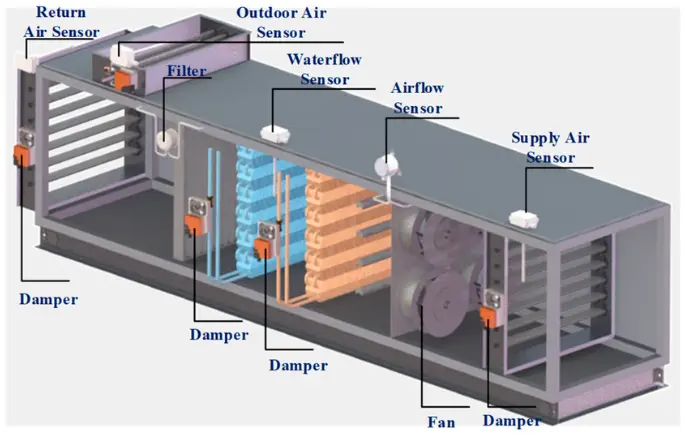
An Air Handling Unit (AHU) is a central HVAC assembly designed to:
- Regulate airflow
- Control air temperature
- Manage humidity levels
- Filter contaminants
- Deliver fresh air to occupied spaces
AHUs are typically connected to ductwork systems and operate alongside chillers, boilers, heat pumps or district energy systems.
In non-residential buildings, AHUs play a vital role in:
- Maintaining occupant comfort
- Ensuring healthy indoor air quality
- Meeting regulatory ventilation requirements
- Supporting energy efficiency targets
2. Core Components of an AHU
An AHU is modular in design and consists of several integrated sections:
2.1 Mixing Box & Dampers
Control the ratio of fresh outdoor air and recirculated return air. Motorised dampers adjust airflow proportions dynamically.
2.2 Filtration Section
Removes:
- Dust
- Particulate matter (PM1, PM2.5, PM10)
- Pollen
- Airborne contaminants
Modern systems comply with ISO 16890 filter standards.
2.3 Heating & Cooling Coils
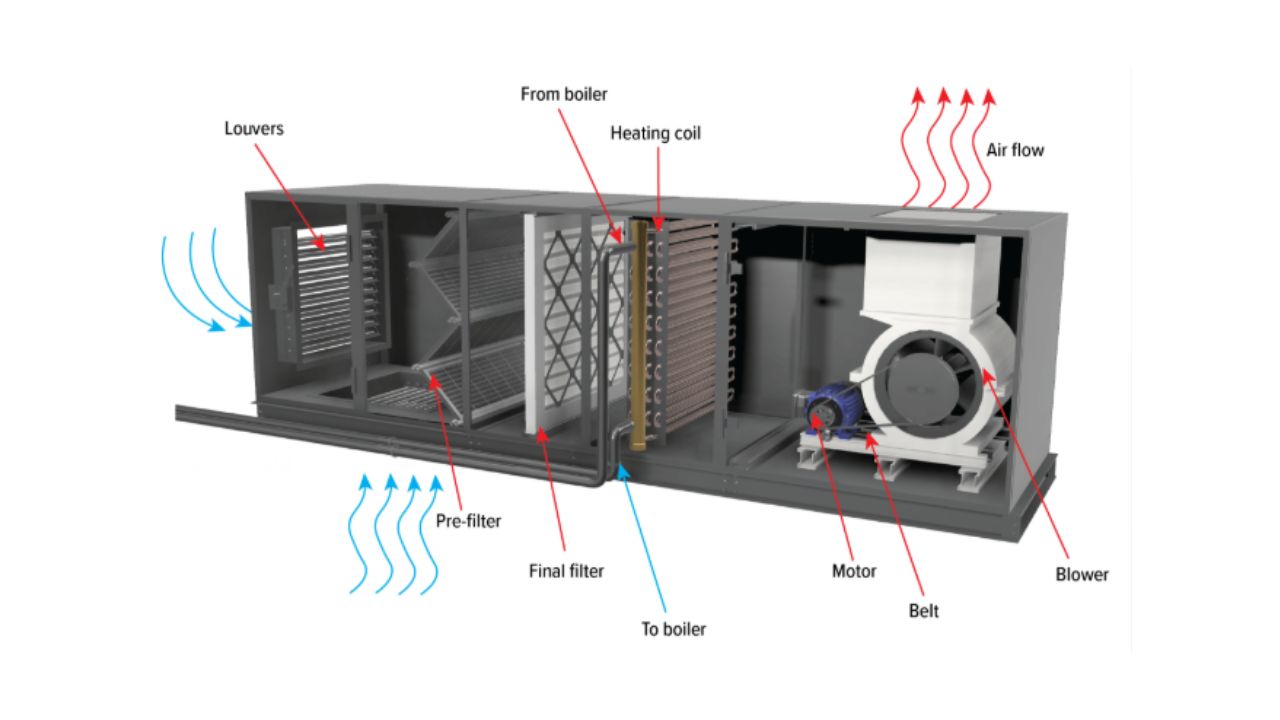
- Cooling coils use chilled water or DX refrigerant.
- Heating coils use LTHW, electric, or steam sources.
These coils regulate supply air temperature.
2.4 Fans & Air Movement
Supply and return fans move air through the unit and into the building.
Modern AHUs often use:
- EC fan arrays
- Plug fans
- Variable speed centrifugal fans
Fan energy consumption is a major contributor to HVAC operating costs.
2.5 Heat Recovery Systems
Many AHUs include:
- Plate heat exchangers
- Thermal wheels
- Run-around coils
Heat recovery improves energy efficiency by reclaiming thermal energy from exhaust air.
2.6 Humidification & Dehumidification
Critical in hospitals, laboratories and pharmaceutical facilities.
3.
How an AHU Works: Step-by-Step Process
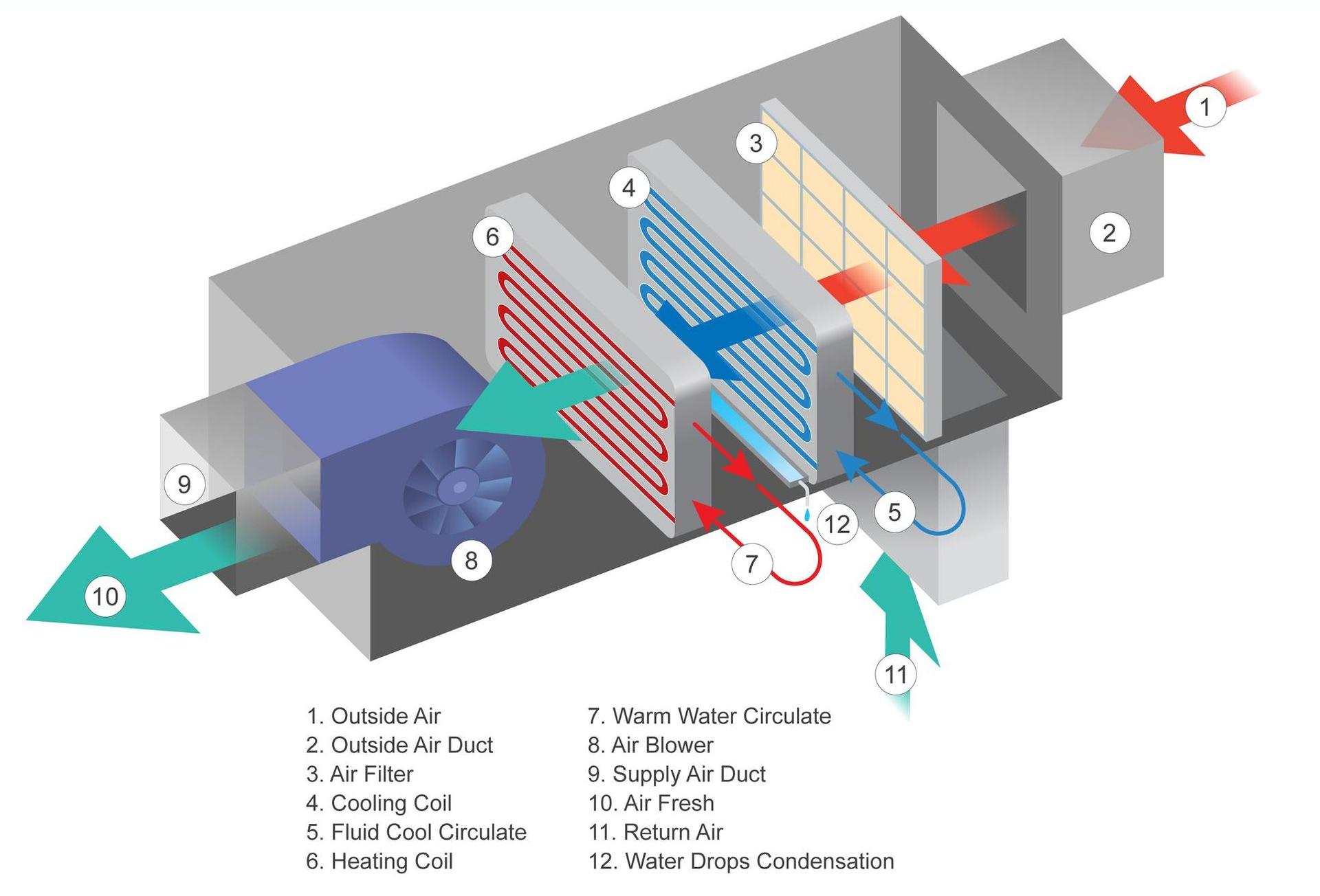
To understand what an AHU does, follow the airflow path:
- Outdoor and return air enter the mixing chamber.
- Dampers regulate air proportions.
- Air passes through filters.
- Heating or cooling coils condition the air.
- Fans distribute conditioned air via ductwork.
- Return air cycles back to repeat the process.
This continuous process ensures stable temperature, ventilation and IAQ.
4. Types of AHUs in Non-Residential Ventilation
Modular AHUs
Custom-built for large commercial applications.
Packaged AHUs
Factory-assembled units for medium-sized facilities.
Rooftop AHUs
Installed externally for space efficiency.
Hygienic AHUs
Designed for healthcare and cleanroom environments.
Each type must meet specific airflow, pressure and efficiency requirements.
5. AHU Energy Efficiency & Performance Standards
Energy performance is critical in non-residential ventilation.
AHUs are evaluated based on:
- Heat recovery efficiency
- Specific Fan Power (SFP)
- Air leakage rates
- Thermal bridging
- Filter resistance
Certification bodies such as Eurovent Certification provide independent verification of performance claims.
In the UK, AHU performance must align with:
- Part L Building Regulations
- SBEM calculations
- BREEAM standards
Energy-efficient AHUs reduce:
- Operational expenditure
- Carbon emissions
- Mechanical strain on chillers and boilers
6. How AHUs Are Controlled
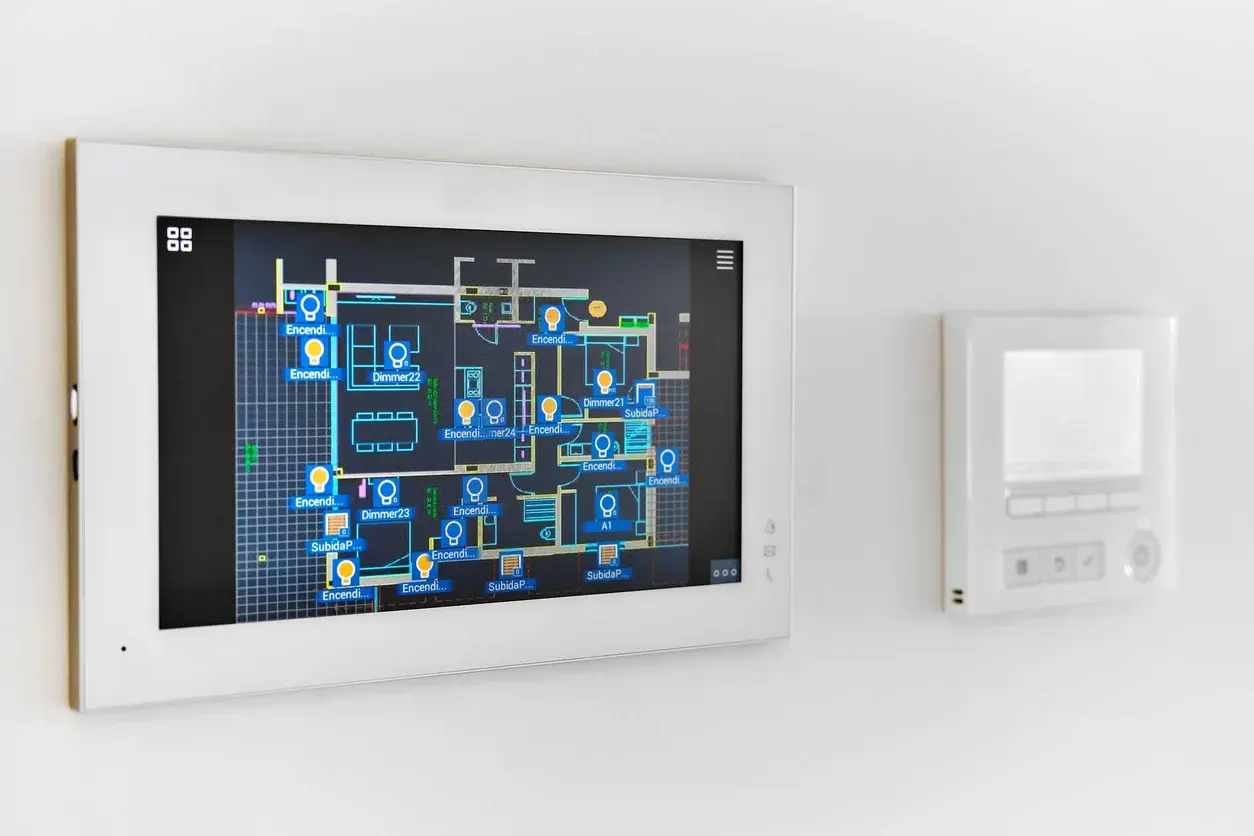
The mechanical design of an AHU determines capacity, but the control system determines performance.
Modern AHU control panels manage:
- Fan speed via variable speed drives
- Coil valve modulation
- Damper positioning
- Static pressure control
- Temperature setpoints
- Frost protection
- CO₂-based demand ventilation
- BMS integration (BACnet/Modbus)
Manufacturers such as Danfoss (VSDs), Belimo (actuators), Sontay (sensors), and Siemens (controllers) provide essential components for high-performance AHU control systems.
Without advanced controls, an AHU may:
- Operate at constant fan speed
- Waste heating and cooling energy
- Fail to meet compliance benchmarks
7. AHU Control Panels & iACS Expertise
At iACS, we specialise in:
- AHU control panel manufacturing
- Bespoke control strategies for ventilation systems
- Integration with Building Management Systems
- Energy optimisation upgrades
- Supplying over 6000 HVAC control components globally
Our AHU control panels are designed to:
- Reduce fan energy consumption
- Optimise heat recovery performance
- Prevent simultaneous heating and cooling
- Ensure compliance with Part L
- Deliver measurable operational savings
We work with trusted brands including:
- ABB
- Carel
- Schneider Electric
Through our ecommerce platform (https://www.i-acs.co.uk/store/), HVAC professionals can access high-quality control components for AHU systems quickly and reliably.
In modern non-residential ventilation, intelligent control panels are not optional, they are essential for achieving efficiency targets.
8. Common AHU Design & Performance Mistakes
- Correct sizing for airflow requirements
- Minimising pressure drop
- Selecting appropriate filter classes
- Ensuring adequate access for maintenance
- Proper commissioning of control systems
- Verifying sensor calibration
Poor commissioning is one of the most common causes of underperformance.
9. FAQs: Air Handling Units Explained
What does an AHU do?
An AHU conditions and distributes air while maintaining ventilation, temperature and air quality.
How does an AHU improve energy efficiency?
Through heat recovery, variable speed fans and intelligent control strategies.
Are AHUs required in non-residential buildings?
Yes, particularly where ventilation and IAQ regulations apply.
Why are AHU controls important?
Controls optimise airflow, prevent energy waste and ensure compliance with performance standards.
Conclusion:
AHUs Are the Backbone of Non-Residential Ventilation
An Air Handling Unit is far more than a ventilation box, it is the central environmental management system within a building.
From filtration and airflow regulation to heating, cooling and heat recovery, AHUs play a critical role in delivering comfort, health and efficiency.
However, true performance depends on advanced control systems. With properly designed AHU control panels and intelligent integration, buildings can significantly reduce energy consumption while maintaining superior indoor air quality.
For HVAC professionals seeking reliable AHU control solutions, iACS provides the expertise and components necessary to ensure systems perform exactly as designed.