
If you are researching “What is the difference between AHU and VRV?”, you are likely comparing two fundamentally different HVAC approaches.
An Air Handling Unit (AHU) and a Variable Refrigerant Volume (VRV) system both provide heating and cooling, but they operate using entirely different principles, scales, and control strategies.
Many online comparisons simplify the distinction to “AHU is for large buildings, VRV is for smaller ones.” While partly true, this explanation misses the deeper engineering, performance and efficiency considerations that HVAC professionals must evaluate.
In this comprehensive guide, we explore:
- What an AHU is and how it functions
- What a VRV system is and how it differs
- Key technical differences between AHU and VRV
- Energy efficiency comparisons
- Application suitability
- The importance of controls in AHU systems
- Expert insight into AHU control strategies
Table of Contents
- What Is an AHU?
- What Is a VRV System?
- AHU vs VRV: Core Technical Differences
- AHU vs VRV: Energy Efficiency Comparison
- AHU vs VRV: Cost & Application Differences
- Why AHU Controls Are Critical to Performance
- When to Choose AHU Over VRV (and Vice Versa)
- FAQs: AHU vs VRV
- Conclusion
1. What Is an AHU?
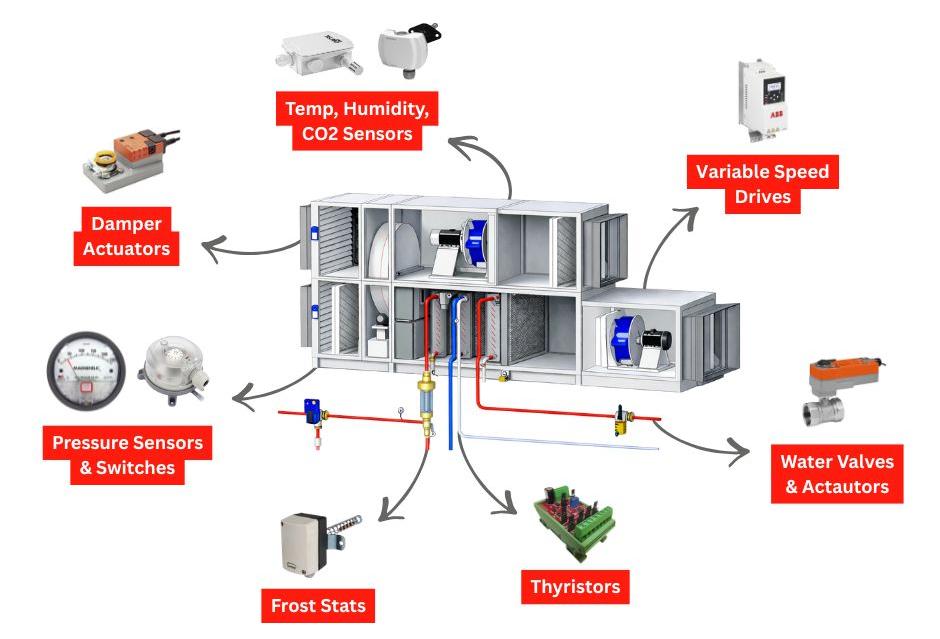
An Air Handling Unit (AHU) is a central HVAC component responsible for:
- Conditioning air (heating, cooling, humidifying, dehumidifying)
- Filtering contaminants
- Mixing fresh and return air
- Distributing air via ductwork
AHUs typically operate as part of a chilled water or DX system and are common in:
- Commercial offices
- Hospitals
- Airports
- Data centres
- Industrial facilities
The AHU does not generate cooling itself — it relies on external chillers, boilers, or heat pumps.
2. What Is a VRV System?
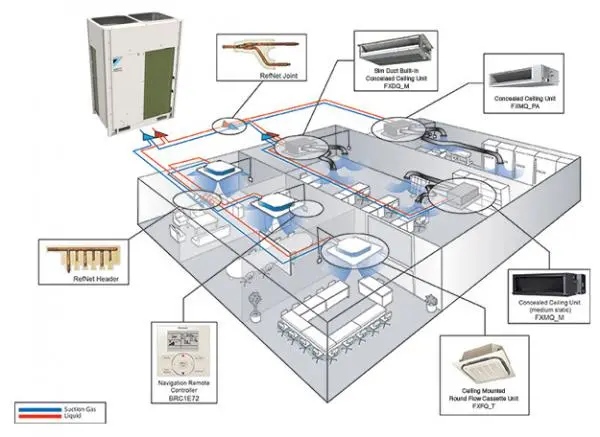
A VRV (Variable Refrigerant Volume) system, also known as VRF (Variable Refrigerant Flow), is a direct expansion (DX) air conditioning system that:
- Uses refrigerant as the cooling medium
- Connects multiple indoor units to a single outdoor unit
- Modulates refrigerant flow based on demand
VRV systems are often used in:
- Medium-sized commercial spaces
- Retail outlets
- Hotels
- Residential complexes
Unlike AHUs, VRV systems do not rely on central air distribution through large duct networks.
3. AHU vs VRV: Core Technical Differences
1. Air vs Refrigerant Distribution
- AHU: Distributes conditioned air via ductwork.
-
VRV: Distributes refrigerant to multiple indoor units.
2. Centralised vs Distributed System
- AHU: Central air treatment and distribution.
-
VRV: Multiple decentralised indoor fan coil units.
3. Ventilation Capability
- AHU: Designed to handle fresh air, filtration and humidity control.
-
VRV: Primarily focused on temperature control; fresh air often requires separate systems.
4. Application Scale
- AHU: Ideal for large, complex or high-occupancy buildings.
- VRV: Suited for zoning flexibility in medium-scale environments.
4. AHU vs VRV: Energy Efficiency Comparison
Energy efficiency depends heavily on system design and controls.
AHU Efficiency Factors:
- Heat recovery integration
- Variable speed fan control
- Demand-controlled ventilation
- Chilled water plant efficiency
-
Advanced AHU controls
VRV Efficiency Factors:
- Inverter-driven compressors
- Load-based refrigerant modulation
- Zonal control
In large commercial buildings with high ventilation requirements, AHUs often outperform VRV systems in long-term efficiency, particularly when integrated with heat recovery and smart controls.
5. AHU vs VRV: Cost & Application Differences
Initial Cost
- VRV systems may have lower installation costs for mid-size buildings.
-
AHUs require ductwork, plant space and additional equipment.
Operational Cost
- VRV systems are efficient in part-load conditions.
-
AHUs can achieve lower cost per square metre in large buildings.
Maintenance
- VRV systems involve complex refrigerant networks.
-
AHUs involve mechanical components but simpler refrigerant pathways.
Compliance
AHUs are typically preferred in buildings requiring:
- Strict air change rates
- Pressure control
- High filtration standards
- Humidity regulation
Such environments include hospitals, laboratories and pharmaceutical facilities.
6. Why AHU Controls Are Critical to Performance
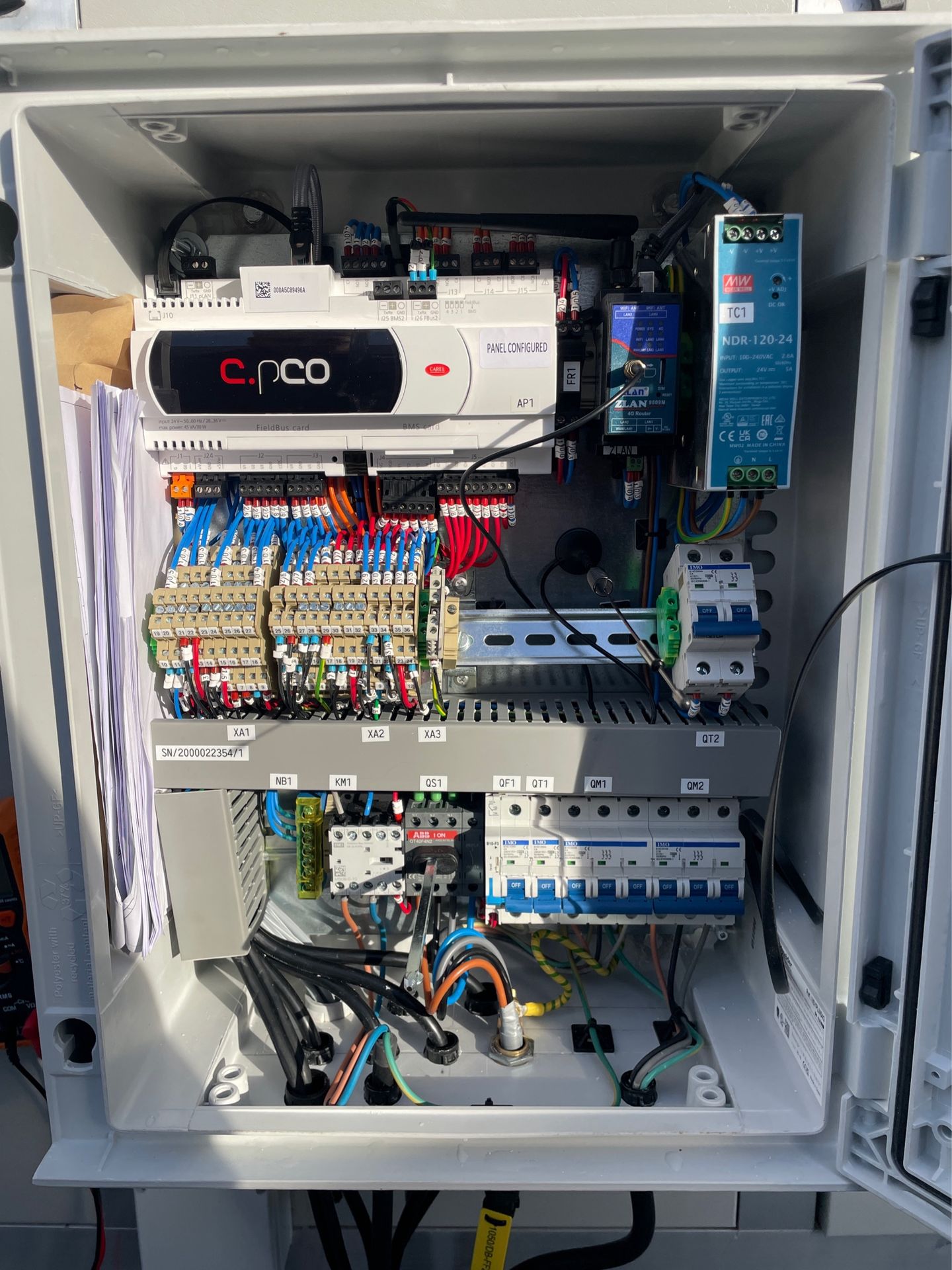
When comparing AHU vs VRV, one major differentiator is control complexity and capability.
The performance of an AHU depends heavily on its control strategy.
Advanced AHU controls manage:
- Variable speed drives (VSDs)
- Coil temperature modulation
- Fresh air and return air mixing
- Frost protection
- Static pressure control
- CO₂-based demand ventilation
- BMS integration
Components from leading manufacturers such as Danfoss (VSDs), Belimo (actuators), Sontay (sensors), and Siemens (controllers) enable high-performance AHU control strategies.
Poor AHU control design can result in:
- Simultaneous heating and cooling
- Over-ventilation
- Excessive fan energy
- Non-compliance with Part L
Advanced control logic ensures AHUs operate efficiently, reliably and in line with regulatory standards.
Our AHU Controls Service & Expertise
At iACS, we specialise in:
- AHU control panel manufacturing
- Bespoke HVAC control solutions
- Integration with Building Management Systems
- Energy optimisation upgrades
- Supply of over 6000 HVAC control components
We work with industry-leading brands and design control strategies tailored to each application.
Our expertise ensures AHUs:
- Achieve projected energy savings
- Meet compliance requirements
- Operate reliably under varying loads
- Deliver measurable operational cost reductions
In large-scale HVAC systems, the quality of the control panel often determines whether theoretical efficiency becomes real-world performance.
7.
When to Choose AHU Over VRV (and Vice Versa)
Choose AHU When:
- Fresh air and ventilation are critical
- Large floor areas require centralised control
- Humidity control is necessary
- Heat recovery is required
-
Compliance standards are strict
Choose VRV When:
- Flexible zoning is required
- Space for ductwork is limited
- Installation speed is a priority
- Moderate building size
In many modern developments, hybrid systems are also used, combining VRV for comfort cooling and AHU for ventilation.
8. FAQs: AHU vs VRV
What is the main difference between AHU and VRV?
AHUs distribute conditioned air through ductwork, while VRV systems distribute refrigerant to multiple indoor units.
Is AHU more efficient than VRV?
For large buildings with high ventilation demands, AHUs with advanced controls can be more efficient long-term.
Which system is better for hospitals?
AHUs are typically preferred due to superior ventilation and air quality control.
Does VRV provide fresh air?
Not inherently. Separate ventilation systems are usually required.
Why are AHU controls important?
AHU controls determine airflow modulation, energy efficiency, compliance and operational performance.
Conclusion: AHU vs VRV – The Right Choice Depends on Application
The difference between AHU and VRV systems lies in scale, distribution method, ventilation capability and control strategy.
VRV systems offer flexibility and zoning advantages. AHUs provide comprehensive air treatment, ventilation management and superior control integration for large or complex buildings.
When properly designed and supported by advanced AHU controls, air handling units deliver:
- Superior ventilation performance
- Improved energy efficiency
- Regulatory compliance
- Long-term cost savings
Understanding the control strategy is just as important as understanding the equipment itself.