
Heat Recovery Units (HRUs) are widely recognised for improving ventilation efficiency and supporting net-zero building design. However, the true performance of any heat recovery system does not lie solely in the heat exchanger, it lies in the HRU controls.
The original discussion around HRUs correctly highlights their environmental benefits. Yet in real-world UK installations, it is the HRU control strategy that determines whether a system achieves 90% efficiency or falls well short.
At iACS, we do not supply HRUs. We specialise in designing and manufacturing advanced HRU control panels that optimise performance, reduce operational costs, and ensure compliance with UK Building Regulations.
This guide focuses on how intelligent HRU controls, heat recovery unit controls, and ventilation control panels drive measurable efficiency gains across commercial, industrial and public-sector buildings.
What This HRU Controls Guide Covers
- How HRU controls reduce energy consumption
- Why heat recovery unit controls determine real-world efficiency
- The role of HRU controls in Part L and net-zero compliance
- Control strategies that reduce fan energy and heating demand
- A sample HRU control sequence for contractors
- FAQs on HRU controls upgrades and optimisation
- Why iACS is the go-to UK specialist for HRU control panels
Table of Contents
- What Are HRU Controls and Why Are They Critical?
- How HRU Controls Reduce Energy Costs
- Advanced HRU Control Strategies That Improve Efficiency
- HRU Controls and UK Net-Zero Compliance
- Example HRU Control Sequence (Technical Overview)
- Real-World Applications of HRU Controls
- Why iACS Is the Go-To Provider for HRU Controls UK
- HRU Controls FAQs
- HRU Controls: Key Takeaways
1. What Are HRU Controls and Why Are They Critical?
HRU controls are the electrical and software systems that manage how a heat recovery unit operates. They regulate:
- Supply and extract fan speeds
- Temperature recovery efficiency
- Bypass dampers
- Frost protection
- Pre-heaters and post-heaters
- CO₂-based demand ventilation
- Integration with Building Management Systems (BMS)
Without advanced heat recovery unit controls, an HRU may:
- Over-ventilate unnecessarily
- Operate fans at constant full speed
- Miss seasonal free cooling opportunities
- Trigger excessive pre-heating
- Fail to optimise energy recovery
In short, the heat exchanger enables recovery but HRU controls unlock the savings.
2. How HRU Controls Reduce Energy Costs
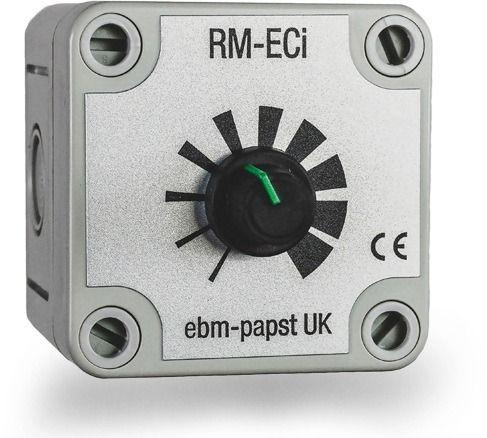
Fan energy accounts for a significant proportion of ventilation system electricity consumption.
Advanced HRU controls use:
- EC fan technology
- Variable Speed Drives (VSDs)
- Pressure sensors for airflow modulation
Manufacturers such as Danfoss provide VSD solutions that integrate directly into HRU control panels.
Because fan power follows the cube law:
- A 20% reduction in fan speed can reduce energy consumption by nearly 50%.
Well-configured HRU controls can therefore reduce electrical costs dramatically compared to fixed-speed systems.
2.2 Demand-Controlled Ventilation (DCV) in HRU Controls
Modern HRU controls UK installations increasingly rely on demand-based ventilation.
By integrating sensors from manufacturers such as:
- Sontay
- Dwyer
HRU controls can:
- Adjust airflow based on CO₂ levels
- Respond to occupancy changes
- Reduce heating load during low occupancy
In office buildings, DCV strategies can reduce ventilation-related heating loads by 20–40% annually.
This is where intelligent heat recovery unit controls outperform basic time-clock systems.
2.3 Intelligent Bypass Control in HRU Controls
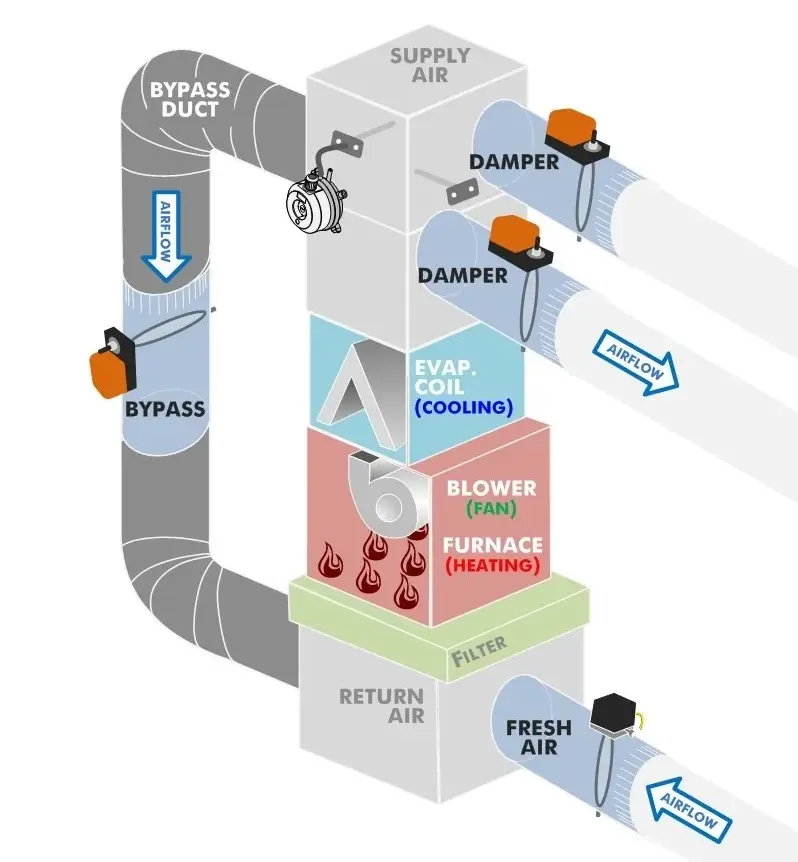
Belimo Damper Actuators > Buy Now
During favourable external conditions, free cooling should be utilised.
Advanced HRU controls:
- Compare return and external air temperatures
- Activate bypass dampers
- Prevent unnecessary heat exchange
Actuators from Belimo ensure precise modulation, enabling HRU controls to maximise seasonal efficiency.
2.4 Frost Protection Logic in HRU Controls
Poor frost control is a common cause of inefficiency.
Advanced HRU control panels integrate:
- Temperature sensors
- Differential pressure switches
- Controlled heater staging
Programmable platforms from Siemens and Schneider Electric allow precise frost algorithms that protect heat exchangers without excessive pre-heating energy use.
3. Advanced HRU Control Strategies That Improve Efficiency
Modern HRU controls include:
- PLC-based automation
- BACnet/Modbus communication
- IoT monitoring
- Remote diagnostics
- Energy performance tracking
These features allow facilities managers to:
- Identify inefficiencies early
- Reduce reactive maintenance
- Optimise seasonal control strategies
- Demonstrate carbon reduction performance
Well-designed HRU controls can reduce overall ventilation energy demand by 30–50% compared to constant-volume systems.
4. HRU Controls and UK Net-Zero Compliance
The UK regulatory landscape increasingly demands measurable efficiency.
HRU controls directly influence:
- Part L compliance
- SBEM calculations
- BREEAM ratings
- NABERS performance scores
Without intelligent HRU controls, an HRU cannot deliver its designed seasonal efficiency.
Optimised heat recovery unit controls reduce:
- Heating demand
- Fan energy
- Carbon intensity
- Operational expenditure
In many commercial projects, upgrading HRU controls alone delivers faster ROI than replacing the entire HRU.
5. Example HRU Control Sequence (Technical Overview)
For HVAC contractors and panel builders, here is a simplified HRU control sequence example:
- Enable signal received from BMS
- Supply and extract fans ramp to minimum speed
- Airflow proven via differential pressure switch
- Temperature sensors compare external vs return air
- Bypass damper modulates for free cooling when appropriate
- Heat exchanger operates under modulating control
- CO₂ sensor adjusts fan speed based on occupancy
- Frost protection activates staged pre-heater if threshold reached
- Fault monitoring reports to BMS
This type of structured HRU controls logic ensures maximum seasonal performance.
6. Real-World Applications of HRU Controls
Commercial Offices: HRU controls reduce ventilation outside working hours, cutting heating bills.
Education Facilities: CO₂-driven HRU controls maintain indoor air quality while reducing holiday energy waste.
Healthcare: Precise HRU control panels maintain air change rates with energy efficiency.
Industrial Facilities: Process-linked HRU controls adapt to production cycles, reducing wasted ventilation energy.
7. Selecting the Right Components for Effective HRU Controls
While HRU controls are often supplied as part of packaged ventilation units, many projects, particularly commercial and industrial installations, require bespoke or upgraded control strategies.
In these cases, system performance depends on selecting the correct components and integrating them properly within the wider HVAC control architecture.
Key Components That Influence HRU Control Performance
Effective HRU controls typically rely on:
- Variable speed drives (VSDs)
- EC fan controllers
- CO₂ and IAQ sensors
- Temperature sensors (supply, return, external)
- Differential pressure switches
- Motorised dampers and actuators
- PLC or BMS-compatible controllers
- Frost protection elements
Manufacturers such as:
- Danfoss (VSDs)
- Belimo (damper actuators)
- Sontay (CO₂ and temperature sensors)
- Carel (controllers)
- ABB (electrical components)
Play a significant role in ensuring HRU controls operate efficiently and reliably.
When upgrading ventilation systems, it is often these components rather than the heat exchanger itself, that determine:
- Seasonal efficiency
- Energy recovery optimisation
- Fault resilience
- Long-term maintenance costs
Retrofitting and Upgrading HRU Controls
In existing buildings, many HRUs operate on outdated control logic:
- Fixed-speed fans
- Basic thermostat-based control
- No demand-based ventilation
- Limited BMS communication
Upgrading the control strategy can deliver substantial improvements in:
- Electrical consumption
- Heating demand
- Carbon performance
- Operational stability
Importantly, this approach can often extend the useful life of the HRU itself, avoiding full replacement costs.
For consultants, contractors and facilities managers, reviewing HRU controls during refurbishment projects can be one of the highest-return energy efficiency measures available.
Conclusion: Why HRU Controls Deserve More Attention
Heat Recovery Units are rightly praised for improving ventilation efficiency and supporting net-zero building targets. However, the real-world performance of these systems depends far more on intelligent HRU controls than on the heat exchanger alone.
Advanced heat recovery unit controls enable:
- Variable fan speed optimisation
- Demand-controlled ventilation
- Intelligent bypass for free cooling
- Effective frost protection
- Full BMS integration
- Measurable carbon reduction
In the UK market, where Part L compliance, SBEM performance and operational energy monitoring are increasingly scrutinised, well-designed HRU controls are not optional. They are essential.
For HVAC professionals, engineers and building operators, the key takeaway is clear:
If you want to reduce cost and improve efficiency, focus on the control strategy, not just the unit.