
As data centres continue to grow in scale, density and complexity, energy efficiency has become one of the industry’s biggest operational priorities.
For many operators, the key metric driving this conversation is:
PUE (Power Usage Effectiveness)
PUE has become the benchmark for measuring data centre efficiency, helping operators understand how much energy is being used by supporting infrastructure compared to actual IT load.
Historically, improving PUE focused heavily on:
- More efficient chillers
- Advanced CRAH/CRAC units
- Liquid cooling technologies
- Improved containment systems
But while mechanical innovation remains important, a major opportunity is often overlooked:
The HVAC control strategy behind the cooling infrastructure.
Today, intelligent HVAC controls are becoming one of the most effective ways to improve efficiency, reduce unnecessary energy consumption and optimise cooling performance dynamically.
Because in modern data centres:
- Efficiency is not just mechanical
- It is behavioural, responsive and algorithmic
This blog explores how intelligent HVAC controls reduce PUE in modern data centres and why control optimisation is now critical for sustainable digital infrastructure.
What This Blog Covers
- What PUE means in data centre environments
- Why HVAC systems heavily impact PUE
- How intelligent controls reduce energy consumption
- The role of airflow optimisation and VSDs
- Why environmental visibility matters
- How dynamic cooling strategies improve efficiency
Tables of Contents
- What Is PUE in a Data Centre?
- Why HVAC Systems Have Such a Major Impact on PUE
- The Problem with Traditional Cooling Control Strategies
- How Intelligent HVAC Controls Reduce PUE
- Variable Speed Drives & Dynamic Fan Control
- Airflow Optimisation & Pressure Management
- Environmental Monitoring & Real-Time Response
- Demand-Based Cooling Strategies
- BMS Integration & Data-Driven Optimisation
- The Role of Intelligent Controls in Sustainable Data Centres
- FAQs: HVAC Controls & PUE Reduction
- Conclusion
1.
What Is PUE in a Data Centre?
PUE (Power Usage Effectiveness) is the industry-standard metric used to measure data centre energy efficiency.
It compares:
Total Facility Energy
vs
Energy Used by IT Equipment
PUE Formula:
PUE = Total Facility Power ÷ IT Equipment Power
Example:
- Total facility power = 2 MW
- IT equipment power = 1 MW
PUE = 2.0
The closer the value is to 1.0, the more efficient the facility.
Why HVAC Matters to PUE
Cooling systems are one of the largest non-IT energy consumers in data centres.
This includes:
- CRAH units
- CRAC systems
- Chillers
- Pumps
- Cooling tower fans
- Air handling units (AHUs)
Poorly optimised HVAC systems significantly increase PUE.
2. Why HVAC Systems Have Such a Major Impact on PUE
Traditional cooling systems often operate conservatively to avoid thermal risk.
This commonly results in:
- Excessive airflow
- Overcooling
- Constant fan operation
- Inefficient pressure management
- Poor cooling distribution
Many facilities intentionally oversupply cooling because operators lack confidence in environmental visibility or control responsiveness.
This creates major energy waste.
The Hidden Issue: Cooling Systems Running “Just in Case”
Without intelligent controls:
- Fans run at full speed unnecessarily
- Cooling systems react slowly
- Equipment sequencing becomes inefficient
- Airflow balancing is inconsistent
This not only increases energy usage, it also reduces operational efficiency and system lifespan.
3. The Problem with Traditional Cooling Control Strategies
Many data centres still operate using static cooling strategies.
These systems rely on:
- Fixed temperature setpoints
- Constant fan speeds
- Basic sequencing logic
- Reactive rather than predictive control
The result is:
- Slow adaptation to changing IT loads
- Excessive energy consumption
- Reduced cooling efficiency
- Unnecessary mechanical stress
As rack densities fluctuate dynamically, static control strategies are no longer sufficient.
4. How Intelligent HVAC Controls Reduce PUE
Modern HVAC control systems improve efficiency by dynamically adjusting cooling behaviour based on real-time environmental demand.
This includes:
✔ Dynamic Fan Speed Control
Adjusting airflow based on thermal conditions.
✔ Intelligent Sequencing
Optimising which units operate and when.
✔ Pressure Optimisation
Maintaining stable airflow while minimising fan energy.
✔ Environmental Monitoring
Responding to rack-level thermal conditions.
✔ Predictive Response
Adjusting before critical thresholds are reached.
This creates a system that operates:
- More efficiently
- More responsively
- More sustainably
5.
Variable Speed Drives & Dynamic Fan Control
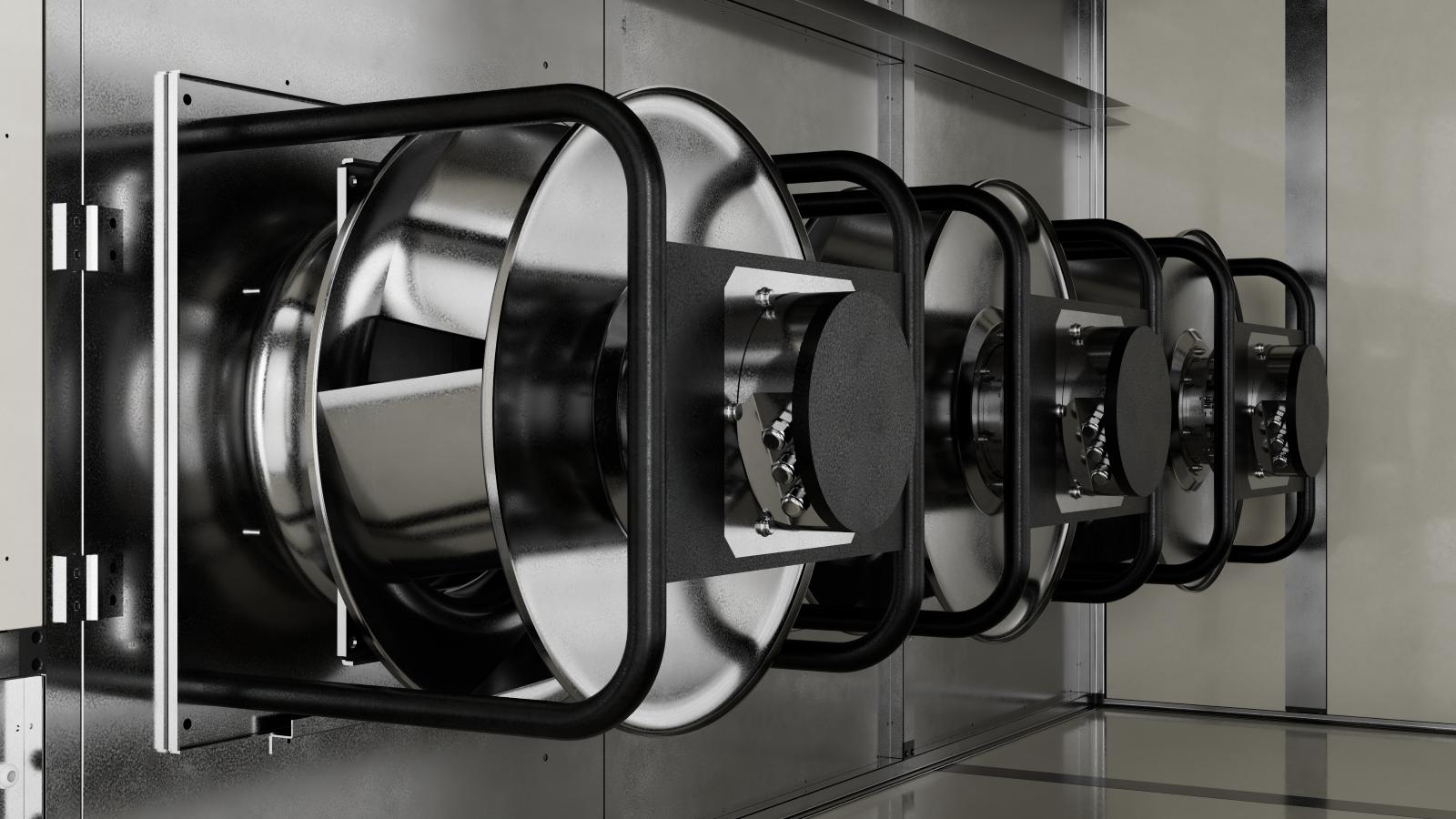
Fan systems are one of the largest contributors to HVAC energy consumption.
This is why Variable Speed Drives (VSDs) are critical.
Manufacturers such as Danfoss and ABB provide advanced drive solutions widely used in critical cooling systems.
Why Fan Speed Matters
Fan energy follows the cube law:
Reducing fan speed by 20% can reduce energy consumption by nearly 50%.
Without intelligent controls, many fans operate at unnecessarily high speeds continuously.
Dynamic fan control allows systems to:
- Reduce airflow during lower thermal demand
- Increase responsiveness during peak load
- Improve airflow balancing
- Reduce unnecessary power consumption
6.
Airflow Optimisation & Pressure Management
Efficient cooling is not just about temperature — it is about airflow behaviour.
Poor airflow management creates:
- Hot spots
- Air recirculation
- Pressure instability
- Cooling inefficiency
Intelligent HVAC controls continuously optimise:
- Static pressure
- Supply airflow
- Return airflow
- Air distribution patterns
This helps maintain:
- Stable rack inlet temperatures
- Better cooling distribution
- Reduced fan energy usage
7.
Environmental Monitoring & Real-Time Response
Modern data centres require detailed environmental visibility.
Advanced HVAC controls integrate with:
- Temperature sensors
- Humidity sensors
- Pressure sensors
- Rack monitoring systems
This allows cooling systems to respond dynamically to:
- Thermal load shifts
- Localised hot spots
- Environmental instability
Without detailed monitoring, systems tend to overcool as a safety buffer.
8. Demand-Based Cooling Strategies
Demand-based cooling is one of the most effective methods for reducing PUE.
Instead of operating continuously at maximum capacity, intelligent controls adjust cooling output based on actual demand.
This includes:
- Dynamic airflow adjustment
- Variable chilled water temperature strategies
- Adaptive fan speed control
- Occupancy-independent thermal response
This approach reduces:
- Energy waste
- Equipment runtime
- Mechanical wear
While improving overall cooling efficiency.
9.
BMS Integration & Data-Driven Optimisation
A Building Management System (BMS) provides visibility and operational management across cooling infrastructure.
Modern BMS integration enables:
- Real-time energy monitoring
- Alarm management
- Trend analysis
- Cooling performance analytics
- Predictive maintenance strategies
However, the BMS is only as effective as the control strategy behind it.
True optimisation comes from combining:
- Intelligent HVAC controls
- Detailed environmental sensing
- Data-driven operational logic
10. The Role of Intelligent Controls in Sustainable Data Centres
Sustainability is becoming a major driver in data centre design.
Operators face increasing pressure to:
- Reduce carbon emissions
- Improve energy efficiency
- Lower operational costs
- Support ESG targets
Intelligent HVAC controls play a critical role in achieving these goals.
By optimising airflow and cooling response dynamically, facilities can:
- Lower energy usage
- Improve PUE
- Reduce mechanical stress
- Extend equipment lifespan
The future of sustainable data centres will rely heavily on control intelligence, not just cooling capacity.
Where iACS Fits In
At iACS, our data centre HVAC control solutions focus on:
- Intelligent cooling optimisation
- Dynamic airflow management
- Energy-efficient control strategies
- Advanced AHU and CRAH integration
- Environmental visibility
- Resilient, scalable control architecture
Because in modern data centres:
Efficiency is not just mechanical, it’s intelligent.
11. FAQs: HVAC Controls & PUE Reduction
What is PUE in a data centre?
PUE (Power Usage Effectiveness) measures how efficiently a data centre uses energy compared to the power consumed by IT equipment.
How do HVAC controls reduce PUE?
By optimising airflow, fan speed, cooling response and environmental stability dynamically.
Why are VSDs important in data centre cooling?
They reduce fan energy consumption by adjusting motor speed based on demand.
What is demand-based cooling?
A strategy where cooling systems adjust output dynamically based on real-time thermal conditions.
Conclusion: The Future of Efficient Cooling Is Intelligent Control
As data centres continue to evolve, cooling efficiency is becoming increasingly dependent on control intelligence.
The facilities achieving the lowest PUE values are not simply installing larger cooling systems, they are deploying:
- Smarter control strategies
- Dynamic airflow optimisation
- Real-time environmental monitoring
- Intelligent sequencing and automation
Because ultimately:
The most efficient cooling system is the one that only uses exactly what is needed, exactly when it is needed.
If you're looking to improve cooling efficiency, reduce PUE and optimise critical cooling infrastructure: